

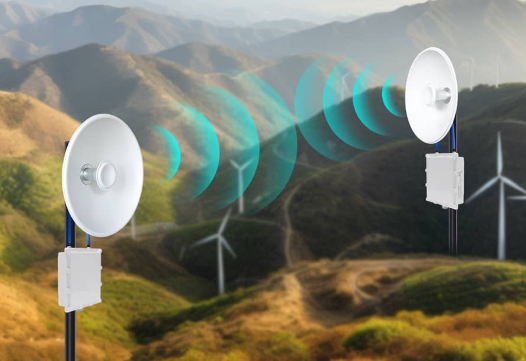
Why Rural Sites Need a Wireless Bridge
Getting fast internet to the farmhouse is only half the problem. Barns, silos, equipment sheds, remote pumps and field-edge CCTV cameras are often hundreds of meters — or several kilometers — from the building where the Starlink dish or 4G router actually lives. Running buried cable across that distance is expensive and slow. A 5.8 GHz wireless bridge (also called a CPE, or customer-premises equipment) lets you broadcast the existing connection from one central point to outbuildings and remote sites at distances up to 20 km, provided you have line-of-sight.
What Is a 5.8G Wireless Bridge / CPE
A wireless bridge is a pair — or a hub-and-spoke set — of outdoor radio units that create a dedicated, point-to-point data link. Each unit connects to your network with an Ethernet cable and is powered over that same cable using Power over Ethernet (PoE). The 5.8 GHz band is unlicensed in most regions, which means no spectrum fees and quick deployment. PLZTECH 5.8G bridges are built for outdoor use, with weatherproof housings and integrated or external high-gain antennas.
Point-to-Point (PtP) vs Point-to-Multi-Point (PtMP)
Choose the topology that matches your farm layout:
- Point-to-Point (PtP): One transmitter talks to exactly one receiver. Best for a single long shot — for example, linking the main house to a distant barn 8 km away. PtP gives the highest throughput because all radio capacity is dedicated to one link.
- Point-to-Multi-Point (PtMP): One central base station serves several remote clients (a silo sensor node, a gate camera, a workshop). Best when you have multiple buildings spread around a central yard. Throughput is shared among the clients.
Line-of-Sight: The Single Most Important Factor
5.8 GHz radio needs a clear, unobstructed path between antennas. Trees, grain silos, machinery and terrain curves will block or weaken the signal. Before you buy, do a simple survey:
- Stand at the planned antenna height at each site and look toward the other.
- Use a phone terrain tool or a pair of binoculars to confirm no solid obstruction sits in the path.
- If the path is blocked, raise the mast — even 2–3 meters can restore a workable link.
Remember that the Earth itself curves; at 20 km the far end must be roughly 30 meters higher (or mounted on a tower or mast) to keep line-of-sight. This is why farm water towers and silo tops make excellent bridge sites.
Antennas and Radio Basics
Bridge kits ship with either integrated antennas (built into the radio) or connectorized radios that accept external antennas. Higher gain (measured in dBi) focuses the beam and extends range, but narrows the acceptable aiming tolerance — you must aim more precisely. For a 20 km link, plan for a pair of high-gain directional units with clear line-of-sight and at least a small margin of signal strength above the manufacturer's receive-sensitivity specification.
Powering Remote Sites with PoE
Each bridge radio draws only a few watts and is powered through the Ethernet cable by an injector or a PoE switch. On a farm this matters because the remote end may have no convenient AC outlet. Options include:
- A PoE injector fed from the existing barn mains.
- A PoE switch near the central Starlink or router for several client radios.
- An off-grid LiFePO4 power station driving a small PoE injector for truly remote sensors.
PLZTECH PoE switches and injectors are rated for outdoor enclosures and help keep the whole link simple.
Expected Throughput and Latency
A wireless bridge does not create new bandwidth — it carries whatever the central Starlink or 4G link provides. On a clean 20 km PtP link you can typically expect a large fraction of the radio's rated PHY speed, limited mainly by distance, modulation and weather. Keep in mind that the remote site shares the central connection, so plan capacity for the busiest simultaneous use, such as a camera upload plus a worker on Wi-Fi.
Dealing with Interference
The 5.8 GHz band is shared, so nearby Wi-Fi, radar and other bridges can compete for airtime. Reduce problems by selecting a quiet channel during installation, using narrow-beam antennas that reject off-axis noise, and enabling any proprietary TDMA or airtime-fairness features your radios support. A site with several bridges should use a coordinated channel plan.
Step-by-Step Deployment
- Plan the topology. List every building or device that needs connectivity and decide PtP vs PtMP.
- Confirm line-of-sight between sites using the survey method above.
- Mount the radios on poles, walls or masts using PLZTECH mounts from our product catalog, aiming the integrated antennas at each other.
- Run a short Ethernet patch from each radio to the local switch, PoE injector or device.
- Power up and align. Use the radio's signal-strength indicator (LED or web UI) to fine-tune aim for maximum RSSI.
- Test throughput with a speed test at the remote end; expect a fraction of the central link speed, shared across clients in PtMP.
- Weatherproof the joins with the supplied cable glands and UV-stable tape.
Farm & Rural Use Cases
- Barns and workshops: Extend Wi-Fi and camera coverage to equipment storage without trenching.
- Silos and grain monitoring: Connect weight, temperature and moisture sensors to the yard network.
- Remote pumps and irrigation: Link PLCs and telemetry so you can monitor water levels from the house.
- Field-edge CCTV: Stream security and livestock cameras from gates and paddocks back to a recorder.
- Guest or worker Wi-Fi: Provide coverage at a distant cabin or seasonal labor housing.
Choosing PLZTECH Bridge Products
Our 5.8G wireless bridge and CPE range covers short-yard links up to long 20 km shots, with weatherproof housings, PoE support and optional external antennas. Pair them with our outdoor connectivity solutions for a complete rural deployment. For background on unlicensed spectrum, see the FCC 5 GHz resources.
Data References
- FCC — 5 GHz unlicensed spectrum overview: https://www.fcc.gov/wireless/bureau-divisions/broadband-division/5-ghz
- IEEE 802.11 standards family: https://standards.ieee.org/ieee/802.11/9620/
- Starlink official service information: https://www.starlink.com/
Frequently Asked Questions
How far can a 5.8G wireless bridge reach?
With clear line-of-sight and suitable high-gain antennas, PLZTECH bridges support links up to 20 km. Real-world range depends on antenna height, terrain and interference.
Do I need line-of-sight for a farm bridge?
Yes. 5.8 GHz signals do not pass through solid obstacles. A clear visual path between the two antennas is required; raising the mast usually solves partial blockage.
Can I power the remote radio off-grid?
Yes. Each radio uses only a few watts over PoE. A small LiFePO4 power station or solar charge controller can run a remote node where no mains power exists.
PtP or PtMP — which should I choose?
Pick PtP for one distant building, and PtMP when a single base station serves several clients such as silos, gates and workshops.