
Start with the surface you actually have
Before comparing mounts, look at where the dish will live. The "best" mount is the one that puts the terminal high enough to clear obstructions while matching the structure you are bolting to. Pipe, wall and flat-roof mounts solve three different problems, and choosing the wrong one usually means a wobbly install or a hole you regret.
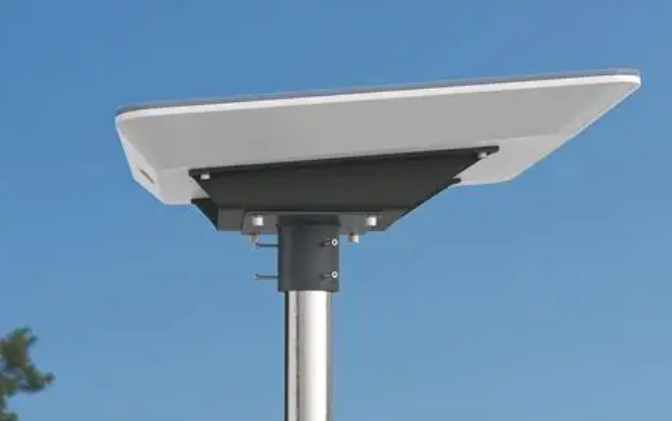
Pipe / pole mount
A pipe or pole mount clamps around a vertical or near-vertical tube — a mast, a railing, a satellite pole, or a dedicated post set in concrete. It is the most flexible option because you control the height: a 2–3 m (6–10 ft) pole on a flat property lifts the dish above trees, HVAC units and neighboring roofs.
- Pros: maximum height and clearance; adjustable azimuth; works on almost any open site; easy to aim.
- Cons: needs a stable base (guy wires or concrete footing for tall poles); more parts; can be overkill for a single-story wall.
- Best for: rural homes, RVs at a fixed camp, WISPs and off-grid sites with no building wall facing the right way.
Install note: use a J-pole or a pole bracket rated for the dish's leverage in wind, and a removable thread locker on the clamps. For marine and vehicle use, 316 stainless clamps resist corrosion.
Wall mount
A wall mount bolts the dish directly to a vertical surface — the gable end of a house, the side of a cabin, or a building facade. It keeps the terminal close to the structure and to existing cable runs.
- Pros: simple, low-profile, short cable run back to the indoors; cheap; rigid.
- Cons: fixed height — you are limited by the wall; the building itself can block part of the sky; harder to aim if the wall does not face the open view.
- Best for: urban and suburban homes where a clear wall faces the satellite arc and roof access is difficult.
Install note: through-bolt with a backing plate rather than screws into siding alone, and seal every penetration with exterior-grade sealant. Tilt the mount so connectors face down.
Flat roof mount
A flat-roof mount uses a weighted or fixed base — often a non-penetrating ballast tray or a bracket fixed to the roof deck — to stand the dish on a level commercial or residential flat roof.
- Pros: no drilling through the roof membrane if you use ballast; elevates the dish above parapets and HVAC; clean look on commercial buildings.
- Cons: ballast trays are heavy and need load approval; wind uplift must be calculated; routing the cable through the parapet or a penetration still needs sealing.
- Best for: warehouses, offices, apartment blocks and any flat-topped building with a clear horizon.
Install note: check the roof's load rating before adding ballast, and use a cable gland where the line crosses the parapet to keep water out.
Materials: aluminum, steel and 316 stainless
| Material | Use | Notes |
|---|---|---|
| Aluminum | Lightweight poles and brackets | Good strength-to-weight; avoid direct contact with steel to prevent galvanic corrosion |
| Galvanized / powder-coated steel | Heavy-duty fixed mounts | Strong and inexpensive; coating must be intact near coasts |
| 316 stainless (A4) | Marine, vehicle, coastal | Best salt resistance; use with isolation washers on aluminum |
Coastal and marine installs should default to 316 stainless. Inland, powder-coated steel or aluminum is usually enough. If you mix metals, separate them with a non-conductive washer to stop galvanic corrosion.
Common mounting mistakes to avoid
Most failed installs come from a few repeat errors. Screwing a wall mount into nothing but vinyl siding lets the dish rip free in the first storm — always through-bolt to structure. Using 304 hardware near the coast means rust stains and seized fasteners within a year; spend the extra on 316. On flat roofs, skipping the load check or leaving a cable penetration unsealed invites a leak and a warranty fight. And never assume a taller pole solves everything: a 6 m mast needs proper guying and a base rated for the leverage, or it becomes a sail.
Buyer decision guide
- Can a wall on the building see the sky clearly? If yes, a wall mount is cheapest and simplest.
- Is the roof flat with a clear horizon and load capacity? A flat-roof ballast mount avoids drilling.
- Do trees, nearby roofs or terrain block the view? A pole mount raises the dish above them.
- Is the site coastal, on a boat or on a vehicle? Choose 316 stainless hardware.
- Will the dish move between sites? A pole or quick-release wall mount is easier to relocate.
Still deciding? Our solutions pages map each mount type to common scenarios, and our product catalog lists the compatible brackets for Mini, Gen3 and 4G routers. For homes see our home solutions and for businesses our business solutions.
Data references
Starlink mounting orientation and fastener guidance: Starlink Help Centre – boat and mobility install. Material selection for corrosive environments: Stainless steel grades overview.
Frequently Asked Questions
Which mount gives the highest view of the sky?
A pole or pipe mount, because you control the height. A 2–3 m post lifts the dish above trees and roofs that would block a wall or low roof mount.
Is a flat-roof mount safe in wind?
Ballast trays avoid drilling but add weight and can lift in high wind, so check roof load and use rated ballast or fixings. Seal any cable crossing with a gland.
What material should I use near the coast?
Default to 316 stainless. Inland, powder-coated steel or aluminum is usually enough. Never let steel touch aluminum directly — separate them with a non-conductive washer.
Can I move the mount later?
Yes. A pole mount or a quick-release wall mount is easiest to relocate; a fixed roof penetration is the hardest to undo.
Starlink is a trademark of SpaceX. PLZTECH supplies independent accessories compatible with Starlink terminals and is not affiliated with or endorsed by SpaceX.